ProductSpace
- class odl.ProductSpace(*spaces, **kwargs)
Bases:
LinearSpaceCartesian product of
LinearSpace’s.A product space is the Cartesian product
X_1 x ... x X_nof linear spacesX_i. It is itself a linear space, where the linear combination is defined component-wise. Inner product, norm and distance can also be defined in natural ways from the corresponding functions in the individual components.- __init__(*spaces, **kwargs)[source]
Initialize a new instance.
Parameters
- space1,…,spaceN
LinearSpaceor int The individual spaces (“factors / parts”) in the product space. Can also be given as
space, nwithninteger, in which case the power spacespace ** nis created.- exponentnon-zero float or
float('inf'), optional Order of the product distance/norm, i.e.
dist(x, y) = np.linalg.norm(x-y, ord=exponent)norm(x) = np.linalg.norm(x, ord=exponent)Values
0 <= exponent < 1are currently unsupported due to numerical instability. SeeNotesfor further information about the interpretation of the values.Default: 2.0
- field
Field, optional Scalar field of the resulting space. Default:
spaces[0].field- weightingoptional
Use weighted inner product, norm, and dist. The following types are supported as
weighting:None: no weighting (default)Weighting: weighting class, used directly. Such a class instance can be retrieved from the space by theProductSpace.weightingproperty.array-like: weigh each component with one entry from the array. The array must be one-dimensional and have the same length as the number of spaces.float : same weighting factor in each component
Other Parameters
- distcallable, optional
The distance function defining a metric on the space. It must accept two
ProductSpaceElementarguments and fulfill the following mathematical conditions for any three space elementsx, y, z:dist(x, y) >= 0dist(x, y) = 0if and only ifx = ydist(x, y) = dist(y, x)dist(x, y) <= dist(x, z) + dist(z, y)
By default,
dist(x, y)is calculated asnorm(x - y).Cannot be combined with:
weighting, norm, inner- normcallable, optional
The norm implementation. It must accept an
ProductSpaceElementargument, return a float and satisfy the following conditions for all space elementsx, yand scalarss:||x|| >= 0||x|| = 0if and only ifx = 0||s * x|| = |s| * ||x||||x + y|| <= ||x|| + ||y||
By default,
norm(x)is calculated asinner(x, x).Cannot be combined with:
weighting, dist, inner- innercallable, optional
The inner product implementation. It must accept two
ProductSpaceElementarguments, return a element from the field of the space (real or complex number) and satisfy the following conditions for all space elementsx, y, zand scalarss:<x, y> = conj(<y, x>)<s*x + y, z> = s * <x, z> + <y, z><x, x> = 0if and only ifx = 0
Cannot be combined with:
weighting, dist, norm
Examples
Product of two rn spaces
>>> r2x3 = ProductSpace(odl.rn(2), odl.rn(3))
Powerspace of rn space
>>> r2x2x2 = ProductSpace(odl.rn(2), 3)
Notes
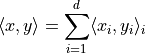
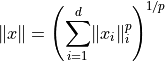
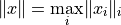
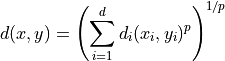
Inner product, norm and distance are evaluated by collecting the result of the corresponding operation in the individual components and reducing the resulting vector to a single number. The
exponentparameter influences only this last part, not the computations in the individual components. We give the exact definitions in the following:Let
 be a product space, and
 ,
,
 ,
,  be
inner products, norms and distances in the respective
component spaces.
be
inner products, norms and distances in the respective
component spaces.Inner product:
Norm:
 :
:
 :
:
Distance:
- :
- :

To implement own versions of these functions, you can use the following snippet to gather the vector of norms (analogously for inner products and distances):
norms = np.fromiter(
    (xi.norm() for xi in x),
    dtype=np.float64, count=len(x))
See Also
ProductSpaceArrayWeighting ProductSpaceConstWeighting
- space1,…,spaceN